
Every day in this country, people who use drugs bring other people back from overdose. Almost none of it is counted, and none of it is paid.
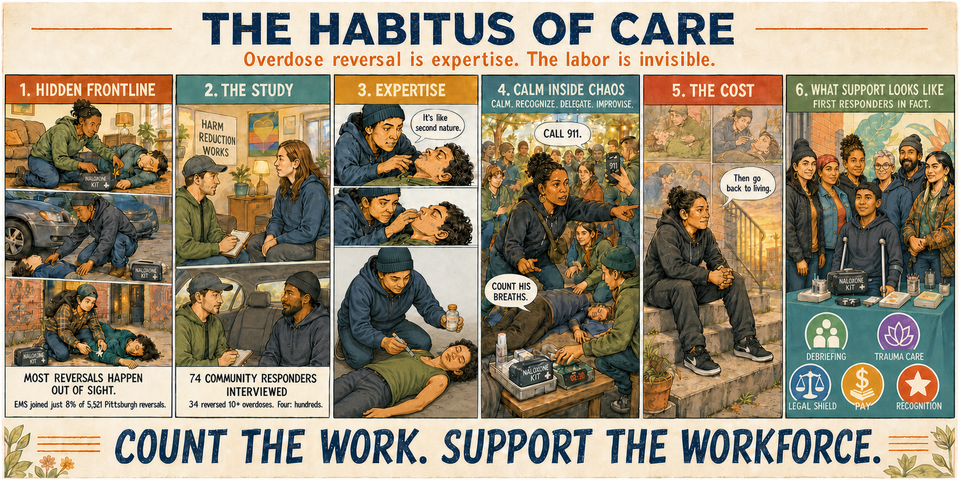
In a new paper in Social Science & Medicine, we interviewed 74 people who had administered naloxone within the past year, recruited through harm reduction programs in western Pennsylvania, western Michigan, and central California. We wanted to understand something that overdose education and naloxone distribution (OEND) programs rarely ask about: Not whether people can be trained to respond, but how they actually get good at it.
The scale surprised us. Thirty-four participants had reversed more than ten overdoses. Four had done it hundreds of times. In our earlier analysis of 17 years of data from Prevention Point Pittsburgh, EMS were involved in just 8% of 5,521 community reversals. The overwhelming majority of overdose response in America happens in living rooms, cars, and alleys — performed by people whose formal training was a short video and a few minutes of instruction at a syringe program.
This is expertise, not luck
Paramedics receive hundreds or thousands of hours of training. Our participants received minutes. And yet what they described is exactly what the literature on expert performance in firefighting, combat, and emergency medicine describes: pattern recognition, calm under pressure, and rapid intuitive judgment.
"It's like second nature. I don't need to be reading instructions. It's just bing, bang, boom. On to the next one." (Pat, MI, 30+ reversals)
"The more experience you get under your belt, it's better. Because then I'm just like, I'm fast-acting instead of delaying my reactions. I used to freeze up... I was like, 'come on, brain, work!'" (Molly, CA, 200+ reversals)
Participants distinguished a nod from an overdose without checking vitals. They titrated doses based on someone's tolerance history. They managed bystanders, delegated 911 calls, and coached themselves through the mechanics. One warned about drawing air into the syringe if you pull the plunger too fast. Felicia (CA, 6 reversals) described holding a pulse, counting between doses, running compressions, and controlling a crowd all at once: "If you don't stay calm, you're gonna get blew up."
Skill accrues the way it does in any profession — through repetition. As Abby (MI, 20 reversals) put it: "I've been through the Narcan trainings... but it's like changing a tire, it's like you know what to do, until you're doing it."
Community naloxone reversals have a 98% survival rate. Reversing opioid overdoses and providing compassionate aftercare by people who use drugs helps reduce 911/EMS burden, allowing them to focus on other emergencies. This benefit of community naloxone distribution is rarely acknowledged in public health circles.
Demanded, devalued, unpaid
Here is the part that should give us pause, an appreciation of humility. Despite mastery comparable to professional emergency response, our participants refused credit.
"I'm just a vessel to help administer the medicine. I'm not, I'm not a supreme being. I don't save anybody." (Terri, PA, 24+ reversals)
Asked why she wasn't on the same level as a firefighter, Beatrice (PA, 3 reversals) answered: "Maybe because we're doing something we're not supposed to be doing, I guess."
That is a structural exclusion, internalized. Professional responders get counseling, paid time off, legal protection, and a title. Community responders get none of it — while carrying a heavier trauma load, because the person turning blue is usually a friend, a partner, or a neighbor. And there is no clocking out.
"You're trying to be really responsible in a way that I think a lot of us are trying to escape from. And now, like, now you gotta be doctor." (Kia, CA, 20 reversals)
Pittsburgh has been here before. Freedom House Ambulance Service, staffed largely by Black community members, invented American paramedicine in 1967 and gave the first community dose of naloxone. It was disbanded in 1975, and many of its veterans were denied city employment for lacking credentials. The same currency — legitimacy — is still being withheld.
Follow the money
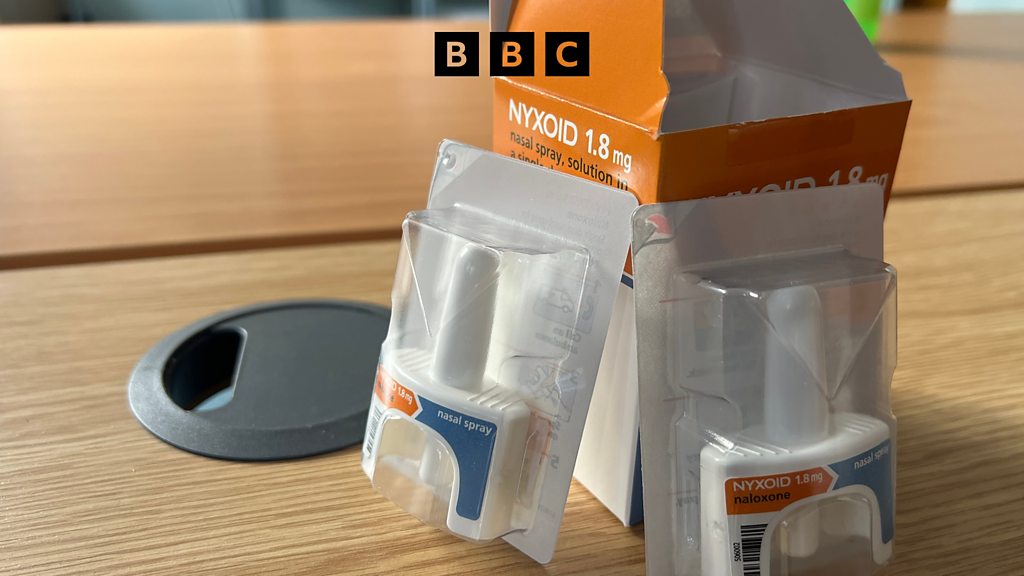
The BBC's Business Daily recently traced what it calls the antidote economy: a drug that costs pennies to make, sold over the counter for $52, and valued at $125 per kit in some opioid litigation settlements. In the final third of the episode, Sam Rivera of OnPoint NYC makes precisely our point, that the labor of reversal is the one input in this supply chain that nobody pays for.

Naloxone saturation is working. But it is a solution premised on a medical technology, not on the workforce that deploys it. If public health is going to keep relying on peer response, then debriefing, mental health care, legal shielding, and actual compensation are not extras. They are what we already give everyone else who does this job.
Distribution models should rely on bulk
Many public health programs pat themselves on the back for getting doses out the door, with no weighting on who was provided with the antidote. Prioritizing networks of people who use drugs should be the number one focus. Think about it this way – Is the person who you're giving naloxone to someone who is in the room when drugs are being used? If the answer is "no" then it's time to re-think your distribution strategy. Look, having naloxone available in schools and libraries helps with de-stigmatizing the intervention. However, let's be clear-eyed on what actually gets naloxone into people's bodies at the right time.
Many participants reversed dozens of overdoses. Naloxone distribution models that only hand out a few doses, or rely on pharmacy purchase, clearly do not address the medication availability needs of Super Savers.
Expertise in different forms
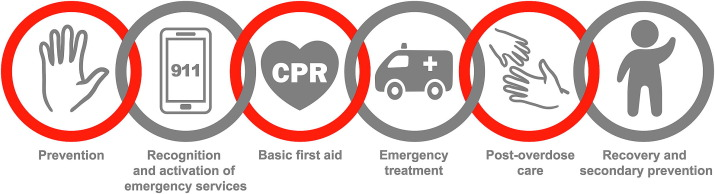
We have previously said that the Chain of Survival for overdose should incorporate high quality assessment and medical attention. We still stand by this; there are many reasons why someone could be down, beyond the overdose, and those conditions (like head wounds from the fall) may also need to be treated. Yet, the reality is that in the US there are waaaaaay more ODs than EMS can possibly handle. And the new study shows there is true expertise that develops. We've seen the same phenomenon arise naturally in other places in the US, Sweden, India, and Viet Nam... people who get a reputation (and responsibility) for reversing overdoses are the ones who get called to help when someone goes down. What are we doing to support the trauma that accumulates?
Acknowledgements
We are grateful to the staff of Prevention Point Pittsburgh (Pittsburgh, Pennsylvania), Red Project (Grand Rapids, Michigan), and SANE — Safer Alternatives through Networking and Education (Sacramento, California) for their support and advocacy in completing this research. We are indebted to Colin Miller for his invaluable efforts during data collection. Most importantly, we thank the 74 participants who selflessly shared their experiences and wisdom with us. Remedy Alliance is a non-profit organization that provides bulk naloxone to health departments and public health programs for free or at cost.
Sibley AL, Joniak-Grant E, Colston DC, Bell A, Doe-Simkins M, Wheeler EJ, Dasgupta N. The habitus of care: Overdose normalization, reversal expertise, and the invisible moral labor of people who use drugs. Social Science & Medicine. 2026. doi:10.1016/j.socscimed.2026.119560
Use of generative artificial intelligence (AI)
We used Claude Opus 4.8 to help generate starter text, that was manually edited. We used ChatGPT Sol 5.6 to generate the comic. In the study, AI tools were used to aid transcription of interviews, but all coding and analysis was done manually.