Causes of the recent rise & decline in US overdose deaths

This post is an update to our original post two years ago on overdose declines. Below is an abridged version of the full white paper Understanding the Recent Rise and Decline of Overdose Deaths in the United States. Grab the full PDF here:

Download the white papers for free
As we've been pondering the causes for changes in overdose rates, we are reminded of this poem:
I do not know which to prefer,
The beauty of inflections
Or the beauty of innuendos,
The blackbird whistling
Or just after.
- Wallace Stevens, Thirteen Ways of Looking at a Blackbird (1954)
No consolation
On an average day in America, there are 180 memorial services for people who died of an overdose. 180 eulogies delivered, hymns sung, wakes, and shivas sat. 180 groups of mourners lighting candles and incense with hands shaking. For loved ones saying final farewells, there is no consolation in recent overdose declines. There is only grief.
Two ways of looking at one number. Since the national peak in overdose mortality in the summer of 2023, overdose deaths have dropped 40%. Yet since that same peak, an additional quarter million people have died of an overdose.
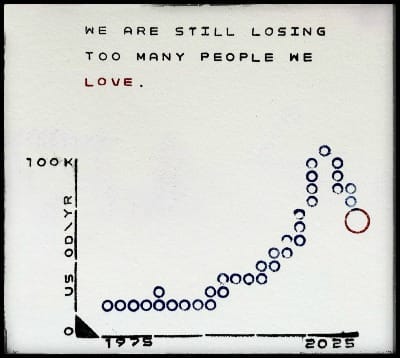
So, let's be clear from the start: We are still losing too many people we love. Now is not the time to let up on the measures that have driven this still-nascent decline.
The paper interrogates three central hypotheses why overdose deaths are declining: drug supply, behavior change, and interventions, and explores why declines seem to be mostly enduring.
A historic increase, then decline
The period from 2023 to 2026 represents the only enduring decline in overdose deaths since the inception of the "War on Drugs" a half-century ago. In 1979, the annual rate of drug overdose mortality was 1.1 per 100,000 U.S. residents. In 2022-23, the rate peaked at 32.3 and 31.1 per 100,000, respectively. By April 2026 the annualized rate had fallen to 19.5 per 100,000.

Over 1.5 million people in the U.S. have died of a drug overdose since 1979. The gray area under the curve in Figure 1 is a paltry representation of our immense collective grief. From apex in August 2023 with 112,418 annualized overdose deaths, numbers have declined to an estimated 66,937 in the 12 months ending April 2026, an unprecedented decline from peak of -40.5%. We investigate this trend to make sense of the grief we have experienced, and to speed the downward trajectory to its elusive nadir at zero.
Waves of acceleration
The co-timing of the sudden increase in overdose deaths with the onset of the COVID pandemic in 2020 cannot be ignored. It has been estimated that up to 49% of the increase in overdose deaths in 2020 could be due to factors related to COVID and restrictions.
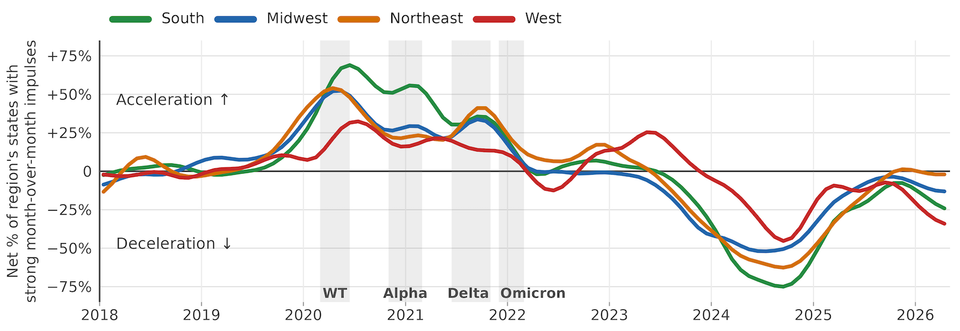
The four waves of coronavirus variants (Wild-type, Alpha, Delta, and Omicron strains) map closely with increases in overdose deaths. Figure 2, stratified by the four U.S. Census Regions, depicts month-over-month changes in population-adjusted overdose mortality rates, calculated by OD Pulse at Northwestern University. This impulse measurement allows us to visualize sudden accelerations or decelerations in overdose death rates.
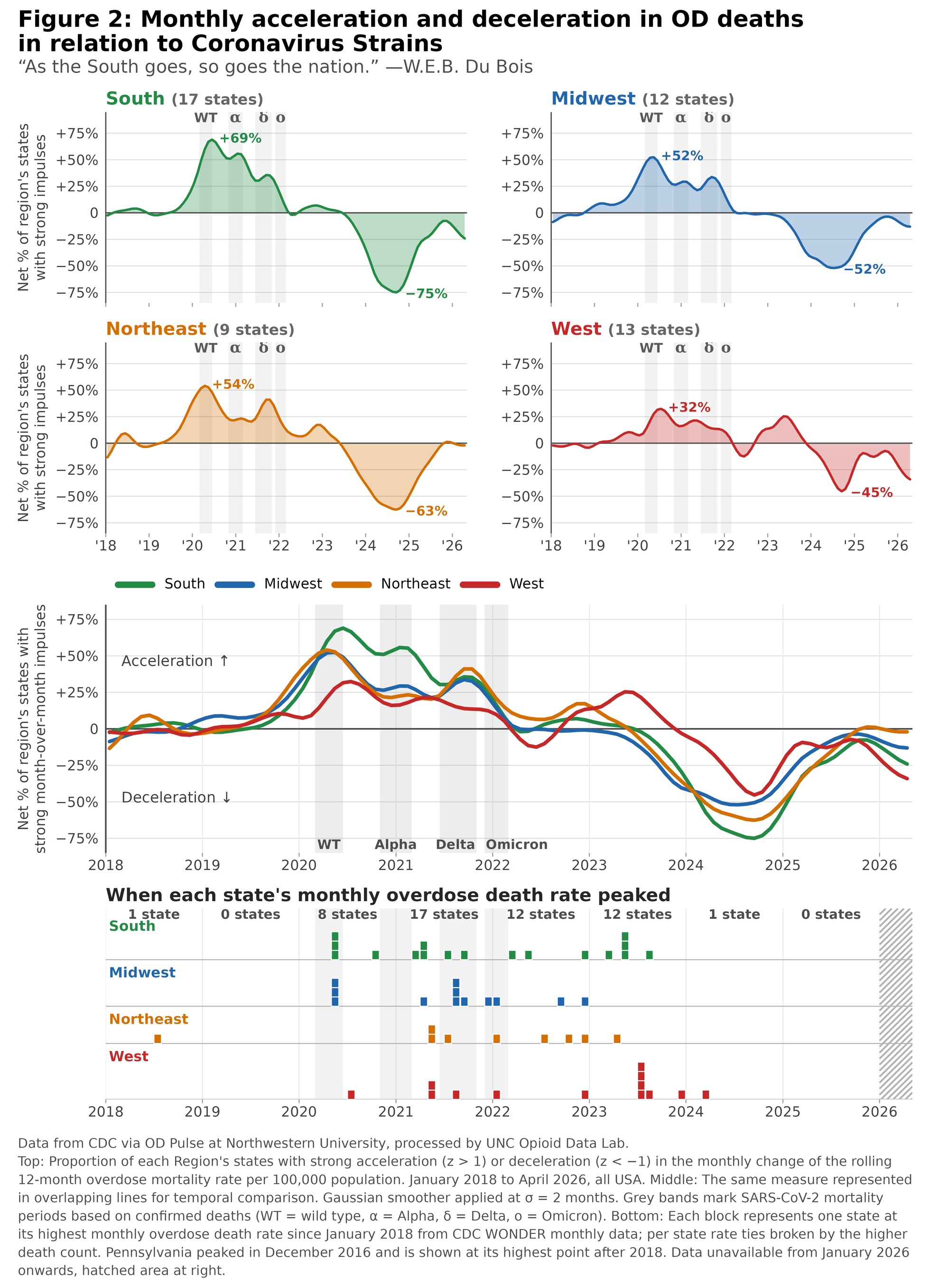
The pattern is most clearly seen in the South, with overdose peaks corresponding to the first three variants. The bottom panel of Figure 2 shows that eight states hit their peaks in 2020, with 17 peaking in 2021, and 20 more states peaking before mid-2023. For all regions, the greatest decelerations occurred in 2024. Our team, and others, have also modeled this regional heterogeneity in-depth, and found caution against an exogenous single-cause explanation for 2023 to be the national overdose death inflection point.
The recent period of exponential increase in overdose deaths (2020 to 2023) appears to be the culmination of successive impulse waves of acceleration. Conceptually, this can be likened to consecutive tsunami waves generated by an underwater earthquake; each wave impulse building on the momentum of the previous, with later waves being the most destructive cumulatively.
A splintered, adulterated drug supply
A fentanyl production ban in China in 2018 created an opportunity for nearshoring fentanyl production to México. The central government of the People's Republic of China outlawed the export of fentanyl products and raw material in late 2017, with the UN International Narcotics Control Board following in early 2018. Paradoxically, the steepest increase in drug overdose deaths ever recorded in the U.S. immediately followed.
By 2023, inter-cartel competition and arrests of high-level drug trafficking network leaders splintered upstream fentanyl supply. By 2024, amidst an internecine battle, the wholesale price for a kilogram of fentanyl locally doubled to USD $6,000.
One highly publicized theory forwarded by the Drug Enforcement Administration (DEA) and Vangelov et al. attributes the decline in overdose deaths to lower fentanyl "purity" beginning in 2023. However, upon independent replication, we found that stimulated reporting of wholesale samples by DEA may have led to an undetected data artifact. A constriction of fentanyl supply may well have happened, but more likely in 2024.
As a market correction to reduced availability of fentanyl, American drugs became characterized by heavy adulteration. Based on mass spectrometry of donated drug samples (Figure 3), we the UNC Street Drug Analysis Lab (and others) report that starting in early 2024 there was a massive influx of adulterants into the unregulated fentanyl supply across the country, in rough order of spread: local anesthetics (procaine, lidocaine, tetracaine), caffeine, xylazine, BTMPS, diphenhydramine, and a little later, (dex)medetomidine. Starting February 2024, more than 20% of expected-fentanyl samples only contained trace amounts of fentanyl.
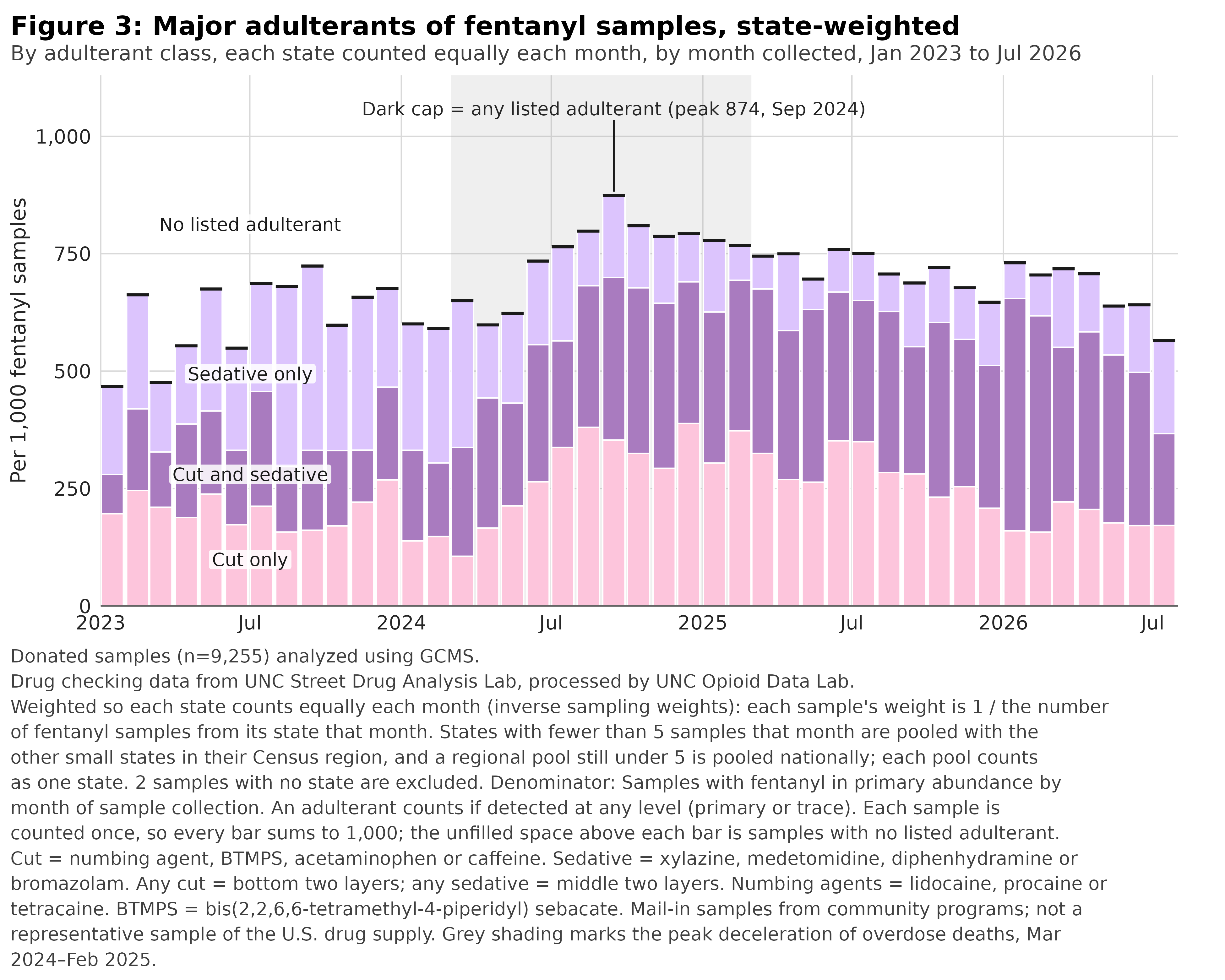
These additives carried additional health harms, but were less immediately lethal. Yet, human xylazine use is known to result in serious skin wounds, and medetomidine withdrawal can cause severe cardiac emergencies: Adulteration should not be treated as a public health strategy.
Off-ramps: behavior change and interventions
Harms from these additives were resoundingly panned by consumers in many studies. In North Carolina, a drug dealer stopped selling because the supply was so heavily adulterated:
When [she] learned [via a drug checking service] what was in the drugs she was consuming and selling, "I was just amazed. I was, like, 'Holy s**t. It's almost pure xylazine; no dope in it." She then stopped selling, and she was soon ready to give it up herself. (source)
The word we keep hearing in our drug checking service at UNC is people asking for "options." In qualitative research, almost all participants reported adapting their use, including reducing amount or frequency, changing routes of administration, abstaining, or seeking treatment.
One particularly consequential behavioral adaptation has been the shift from injecting fentanyl to smoking, documented in a longitudinal study in San Francisco. The perceived benefits have empirical support: In California, those reporting fentanyl injection had 40% higher recent nonfatal overdose rates than those who exclusively smoked.
That off-ramps existed was the consequence of expanded public health interventions, buoyed by the earliest distributions of opioid settlement funds. The U.S. Food and Drug Administration estimated that naloxone distribution in community settings increased from 1.39 million units in 2018 to 16.1 million units in 2023, an increase of more than 11-fold. Expansion of drug treatment was enacted through telehealth, low barrier models, long-acting formulations, Medicaid expansion, and implementation in carceral settings.
Much of this work happens quietly, by dedicated professionals and volunteers. Some examples: Avivo in Minnesota; Health Brigade in Virginia; FIT Clinic in Louisiana; a youth program on South Dakota's Pine Ridge Reservation; Step-Up in Indiana; Amethyst Place in Missouri; the Reno Initiative for Shelter and Equality in Nevada; Olympia Bupe Clinic in Washington; Charm City Care Connection in Baltimore; community EMS in Maryland; pharmacy-based methadone in Appalachian North Carolina; Challenges in South Carolina; and ME-RAP in Maine.
Combined with a less immediately lethal drug supply, by mid-2024 there was a massive deceleration in overdose deaths in most of the nation.
Who is being left behind, by race
Overdose recovery in some racialized groups has been uneven. Compared to whites, nationally from 2018 to 2025 (Figure 4), age-adjusted overdose rates increased among Native Americans (+83%) and Blacks (+37%). Native Americans experienced the shallowest recovery (-23% from peak) compared to whites and Blacks (-40% for both). While African Americans experienced a similar relative decline from peak, their overdose rate in 2025 was still +41% higher than whites, while for Native Americans it was higher by +53%.
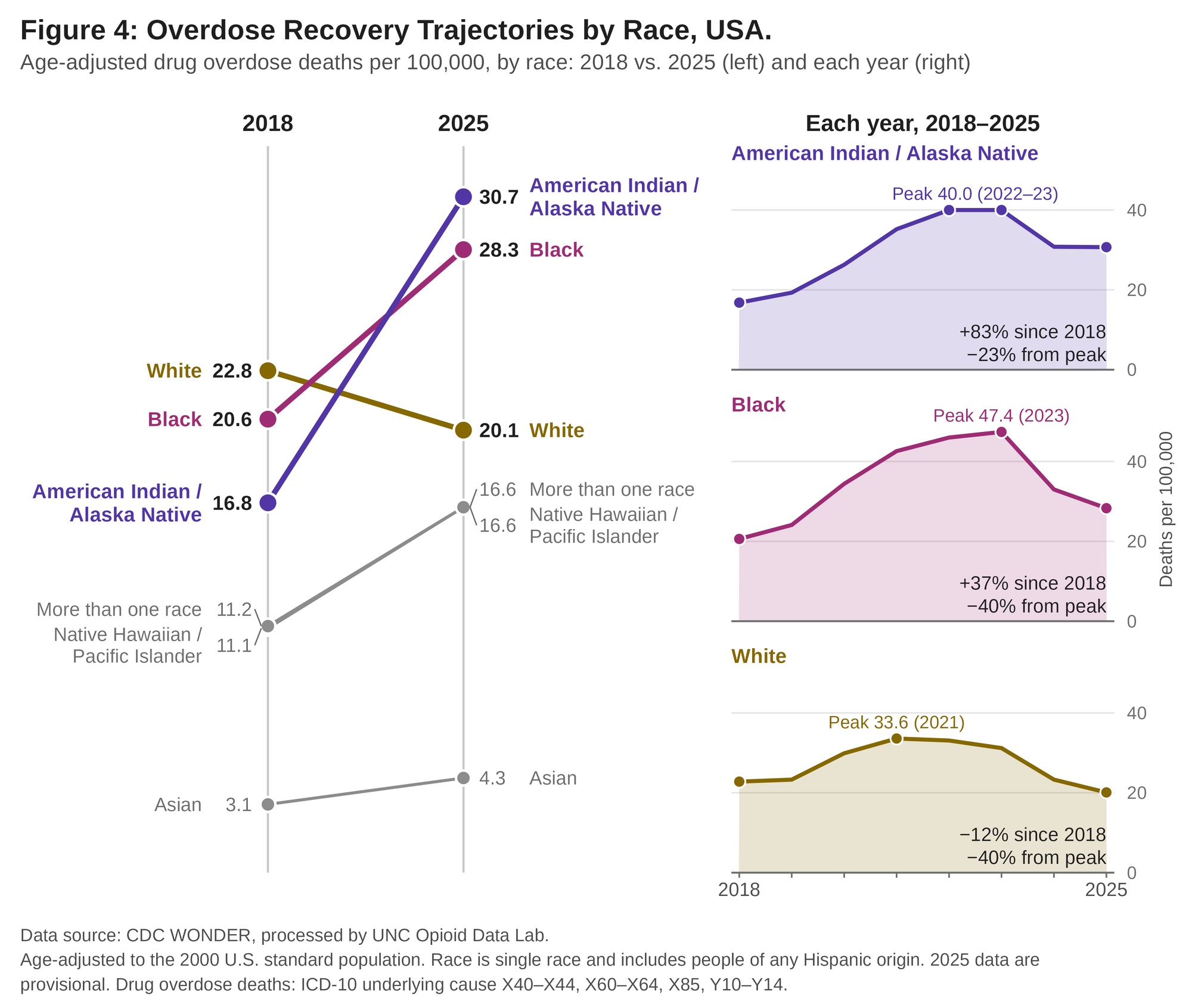
Racial disparities in overdose recovery are a strong indicator that overreliance on drug supply interdiction and ignoring racial disparities is not effective in reducing overdose rates for everyone. A reasonable interpretation of these data is that interventions are not uniformly reaching marginalized communities in the same way as they are helping Whites.
The cumulative impact of these disparities is clear in Missouri (Figure 5). Among Black residents of St. Louis, overdose deaths fell (-44%) from 2023 to 2024, with strong community participation in prevention. The wide scale of interventions deployed (and evaluated) include naloxone distribution, treatment access, and street medicine. In contrast, overdose deaths in Kansas City saw an +11% increase. In Kansas City harm reduction efforts have been heavily constrained by local authorities with limited outreach to Black communities; as a result, Black residents of Kansas City reported carrying naloxone less frequently than White residents.

Where to direct interventions, by generation
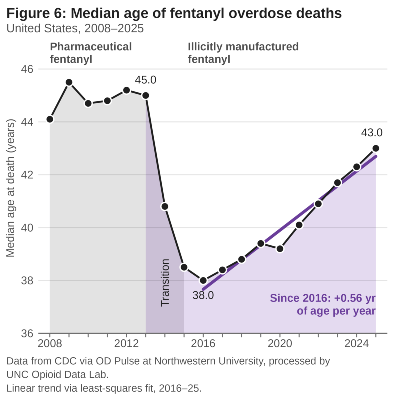
Fentanyl overdose deaths have shown a pattern consistent with an ageing birth cohort. Each year since 2016 (Figure 6), the median age at death has increased linearly, by 0.56 years. This is critical for informing policy because education and interventions are often prioritized for youth over age groups that bear the greatest burden.
The concentration of overdose mortality becomes more evident by US birth generation (Figure 7). A key fact: 70% of overdose deaths in 2025 occurred among Gen X and Millennials. In provisional 2025 data, overdose death rates were 36.6 per 100,000 among Gen X and 34.0 among Millennials, compared with 20.8 among Baby Boomers and 8.6 among Gen Z.
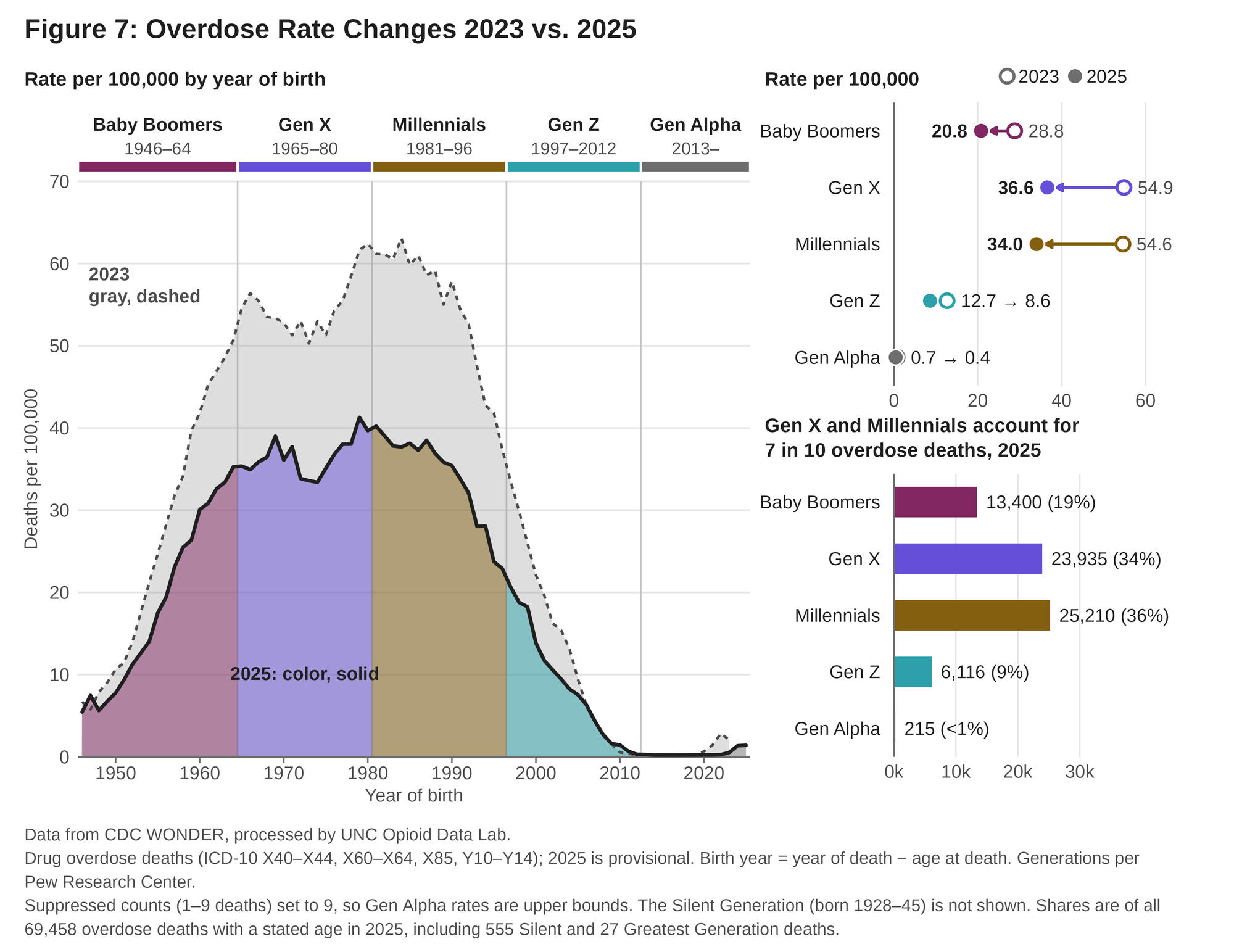
Naloxone, accessible medication treatment, street outreach, housing, and support after incarceration need to reach people in the middle of their lives.
Positive changes were made enduring by age-related shifts among coming-of-age young adults in Gen Z, whose drug tastes shied away from illicit opioids, driven in part by expanding cannabis availability. Gen Z constituted only 9% of overdose deaths in 2025. Younger adults today feel less stigma in disclosing substance use disorders and are more comfortable seeking help than older generations. Still, an analysis comparing 2022 with 2024 identified increases in overdose deaths among the younger birth cohort born from 2005 to 2011. This cohort may become a harbinger of future opioid cycles if their needs are not addressed directly.
A fragile recovery
Overdose declines have coincided with socially positive trends in other indicators, including declining violent crime, motor vehicle fatalities, and suicide mortality among adolescents and young adults. These parallel improvements are consistent with a broader social recovery globally.
These trends are not inexorable. In late 2025, certain areas saw an increase in retail fentanyl concentrations as new manufacturing capacity came online in México. Beyond drug supply, two other factors threaten enduring progress: funding cuts and a decimated frontline workforce. Defunding effective public health and clinical programming is shortsighted. Harm reduction programs and the people they serve are the "last mile" in overdose prevention; there is no more efficient way to get naloxone into the hands of people who will actually use it.
The tragic increase in overdose deaths during the COVID pandemic is one of the greatest failings of public health and public safety in American history. The subsequent overdose declines, as welcome as they are, only bring us back close to pre-pandemic baseline. Rates that were alarming then are just as alarming now. Declines can be made enduring if our attention remains on embracing effective solutions, focusing on those with the highest mortality rates, and avoiding overly simplistic explanations for the overdose decline. Yet, we continue still to lose too many people we love. Our work must continue; it is incumbent upon us to honor their memories and invest in the workforce, infrastructure, and policies that offer humane futures.
Read the full white paper, with complete references:

Suggested Citation
Dasgupta, N. Understanding the Recent Rise and Decline of Overdose Deaths in the United States. Baltimore: Bloomberg American Health Initiative, Johns Hopkins Bloomberg School of Public Health. 20 October 2026. DOI:https://doi.org/10.26144/YT63-WB31
Acknowledgements
Thank you to our team at the UNC Street Drug Analysis Lab for all your daily service. Our gratitude to Lori Ann Post at OD Pulse for proposing impulse metrics and making the data platform publicly available. Thank you to Alison Sutter and Eliza Wheeler for providing community connections. Thank you to Roxanne Saucier, Paula Gildner, Adams Sibley, and Joshua Sharfstein for editorial suggestions, and the JHU team for layout and logistics. This work was supported by the Bloomberg American Health Initiative.